Can Red Light Therapy Help Improve Insulin Resistance? Here’s What the Science Says
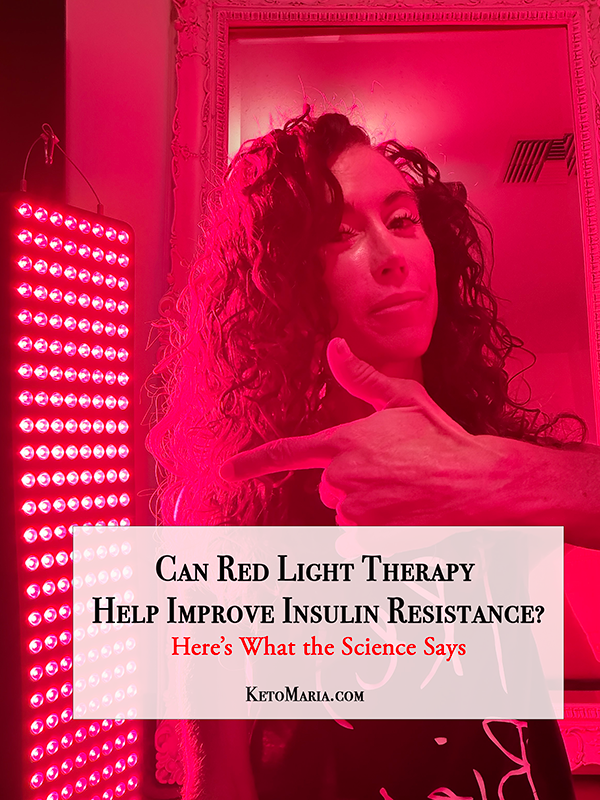
Red light is probably my favorite biohacking practice that I do often. Standing in front of my red light panels, I visualize all the mitochondria in my body doing a “happy dance” while I relax after an intense bought of strength training.
When my husband Craig and I were writing our newest book The Art of Metabolic Health, I knew I had to write a section on my love for red light therapy. During my research I was intrigued by some fascinating research that seems to suggest that not only does red light work wonders for wrinkles, blemishes, scars, recovery, hair growth and sleep; red light therapy can even help improve insulin resistance!

What Is Insulin Resistance?
Insulin is the hormone that tells your cells to absorb glucose from your bloodstream. When your cells become resistant to insulin’s signal, your pancreas has to produce more and more insulin just to keep blood sugar under control. Over time, chronically elevated insulin can contribute to:
- Weight gain
- Fatty liver
- Increased inflammation
- High triglycerides
- PCOS
- Prediabetes
- Type 2 diabetes
- Cardiovascular disease
The question isn’t just, “How do we lower blood sugar?” It’s, “How do we make our cells respond to insulin again?”
How Red Light Therapy Works
Red light therapy uses specific wavelengths of red (typically around 660 nm) and near-infrared light (around 810–850 nm) that penetrate the skin and are absorbed by the mitochondria. Inside the mitochondria is an enzyme called cytochrome c oxidase. When stimulated by red and near-infrared light, this enzyme appears to increase ATP production; the energy currency of every cell. Think of it as giving your cellular power plants a tune-up. More efficient mitochondria can lead to:
- Better cellular energy production
- Reduced oxidative stress
- Less inflammation
- Improved blood flow
- Better tissue repair
These are all processes that become impaired in insulin resistance.
Insulin Resistance Is Really a Mitochondrial Problem
Many people think insulin resistance starts with blood sugar. It doesn’t. Long before glucose rises, mitochondria often begin struggling to efficiently produce energy. Damaged mitochondria generate excess reactive oxygen species (free radicals), creating oxidative stress that interferes with insulin signaling. This creates a vicious cycle:
- Poor mitochondrial function
- More inflammation
- Worse insulin signaling
- Higher insulin levels
- More fat storage
- Even greater mitochondrial dysfunction
Breaking this cycle is one of the keys to restoring metabolic health.
What Does the Research Show?
The newest evidence is encouraging. A 2026 systematic review evaluating clinical studies in people with type 2 diabetes found that photobiomodulation was associated with improvements in:
- Fasting blood glucose
- Post-meal glucose
- Hemoglobin A1c (HbA1c)
- Several metabolic and vascular markers
The authors concluded that red and near-infrared light therapy shows promise as an adjunctive treatment for improving glycemic control. However, they also noted that larger, well-designed human trials are still needed before firm conclusions can be made.
Another systematic review published in 2026 reached similar conclusions, reporting that photobiomodulation appears to improve glucose metabolism across multiple studies, while emphasizing the need for standardized treatment protocols and additional clinical research.
Why Might It Improve Insulin Sensitivity?
Researchers believe several mechanisms may be involved.
1. Better Mitochondrial Function: Healthier mitochondria produce more ATP and less oxidative stress. Since insulin signaling is highly dependent on cellular energy, healthier mitochondria may allow cells to respond more effectively to insulin.
2. Reduced Inflammation: Chronic low-grade inflammation is one of the driving forces behind insulin resistance. Photobiomodulation has repeatedly been shown to reduce inflammatory signaling and oxidative stress in tissues, potentially making cells more responsive to insulin.
3. Improved Blood Flow: Red light therapy increases nitric oxide availability. Nitric oxide relaxes blood vessels, improving circulation and oxygen delivery to muscles—the body’s largest site for glucose disposal. Better circulation means nutrients and insulin can reach tissues more efficiently.
4. Improved Muscle Metabolism: Skeletal muscle uses the majority of the glucose you eat. Some research suggests photobiomodulation may improve mitochondrial performance inside muscle cells, potentially enhancing glucose uptake during and after exercise. This may partly explain why many athletes use red light therapy to improve recovery and performance.
Does This Mean Red Light Therapy Reverses Insulin Resistance?
Not by itself. Think of red light therapy like strength training. Lifting weights doesn’t magically cure diabetes. But it improves muscle mass, mitochondrial health, insulin sensitivity, and glucose disposal. Red light therapy appears to work in a similar way. It supports healthier cellular function rather than replacing the fundamentals.
If you’re living on ultra-processed food, sleeping only four hours a night, and never exercising, a red light panel won’t undo those habits. But combined with:
- A protein-focused diet
- Lower carbohydrate intake when appropriate
- Resistance training
- QUALITY sleep
- Stress management
- Healthy hormone balance
…it may become another valuable tool for improving metabolic health.
My Take
I’m always interested in therapies that address the root cause rather than simply masking symptoms. What excites me about photobiomodulation isn’t that it promises a miracle. It’s that it targets one of the biggest drivers of metabolic disease: mitochondrial dysfunction. The research is still evolving, but it’s moving in an encouraging direction. Will red light therapy replace proper nutrition? Absolutely not. Could it help support healthier mitochondria, lower inflammation, and improve insulin sensitivity as part of a comprehensive metabolic health plan? Based on the current evidence, I believe that’s a reasonable possibility. As always, the foundation comes first.
- Prioritize protein.
- Build muscle.
- Sleep well.
- Balance your hormones.
- Manage stress.
- Then consider red light therapy as one more tool that may help your cells function the way they were designed to.
WHERE TO GET YOUR BON CHARGE RED LIGHT PANEL

The people at Bon Charge are so generous, he is offering the LARGEST discount to my readers!
Use code MARIA to save 20%
That’s the best deal out there for this product!
BON CHARGE products are all HSA/FSA eligible, giving you tax free savings of up to 40%
CLICK HERE to get a red light panel! Hurry! They sell out often!
References
Rocha FC, et al. Photobiomodulation Therapy to Improve Glycemic Control in People with Diabetes Mellitus: A Systematic Review. Photobiomodulation, Photomedicine, and Laser Surgery. 2026.Effects of Photobiomodulation on Glucose Metabolism and Perspective of Its Practical Applications: A Systematic Review. Endocrinology Insights. 2026.